
What Is Mindfulness?

The University of California Center for Mindfulness, part of the medical school’s psychiatry department, defines Mindfulness Meditation this way:

“(Mindfulness) is a quality, which human beings already have, but they have usually not been advised that they have it, that it is valuable, or that it can be cultivated. Mindfulness is the awareness that is not thinking but which is aware of thinking, as well as aware of each of the other ways we experience the sensory world, i.e., seeing, hearing, tasting, smelling, feeling through the body.

“Mindfulness is non-judgmental, open-hearted, friendly, and inviting of whatever arises in awareness. It is cultivated by paying attention on purpose, deeply, and without judgment to whatever arises in the present moment, either inside or outside of us. By intentionally practicing mindfulness, deliberately paying more careful moment-to-moment attention, individuals can live more fully and less on ‘automatic pilot,’ thus, being more present for their own lives.”

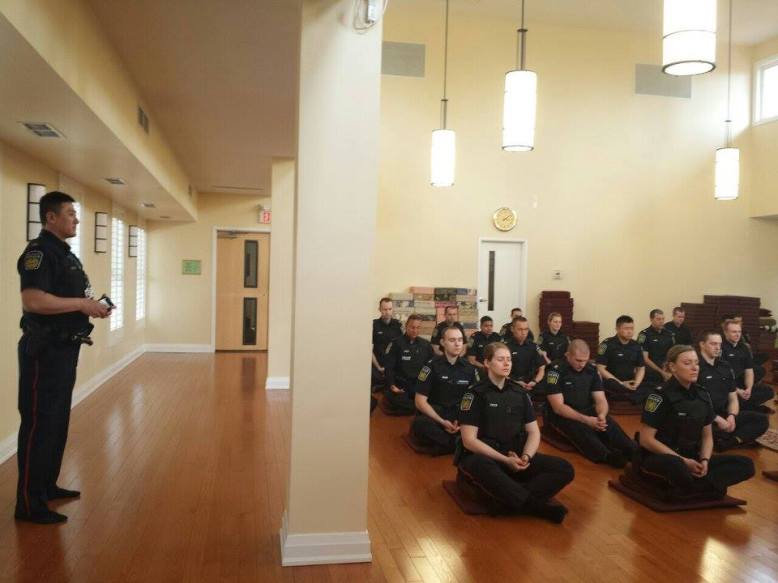
Mindfulness is Being Applied to Professional Settings for its Problem Solving and Decision Making Benefits

Mindfulness is the new buzzword in wellness, but it has its value in so many other areas that it is be incorporated into practice for professions like teaching, law enforcement, and business.

Recently in Canada, Peel Region officers requested a guest lecture and had a meditation lesson at the West End Buddhist Temple and Meditation Centre in Mississauga, Ontario.  The lecture on Buddhist philosophy and mindfulness meditation along with a meditation lesson were given by the Venerable Dr. Bhante Saranapala, an energetic young fellow who goes by the nickname “The Urban Buddhist Monk.”

12936764_612128768936621_7506462692493705079_n

Recent research shows that mindfulness also helps with decision making by clarifying the mind and enhancing creativity. According to Dr. Natalia Karelaia, Assistant Professor of Decision Sciences at the INSEAD Business School in Paris, mindfulness is being incorporated into ‘every area of business where strong decisions are required’.  This is mainly because mindfulness enhances creativity largely by encouraging divergent thinking. But the benefits run much deeper. According to Dr. Karelaia, mindfulness not only helps decision makers reach conclusions, it also impacts the way decisions are identified, made, implemented and assessed.

Heightened awareness ensures that mindful individuals may be more likely to learn the right lessons from experience. It’s a well-known phenomenon in psychology that we often attribute our past success to our own skill and our past failures to some external circumstance. This can lead to overconfidence, which can be quite disastrous in organizational or entrepreneurial situations. More mindful individuals are more likely to disengage from their ego, making them more open to negative feedback. So, mindfulness helps decision makers learn in an unbiased way.